Lucas Museum of Narrative Art: $1-Billion Opening Sept 22, 2026
From Van Gogh and Norman Rockwell to comic books and Star Wars, the Lucas Museum of Narrative Art is rewriting the guest list for which images belong in a museum.
 By Lucas D. Boccheciampe · September 29, 2026
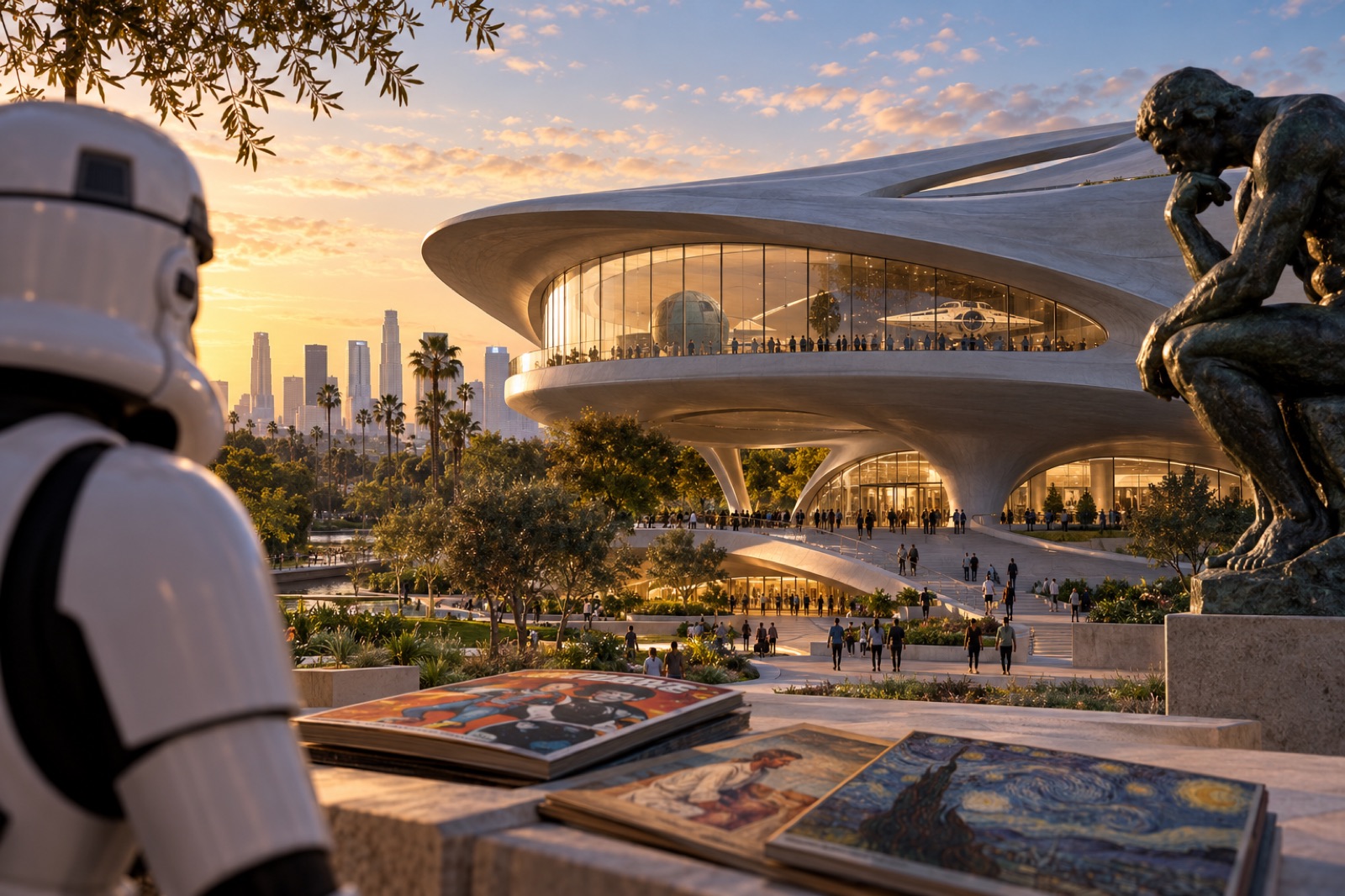
George Lucas spent a career persuading audiences that a space opera could carry the weight of myth. On September 22, 2026, he gets to test a harder proposition: whether the same audiences will accept those images hanging in a museum.
The Lucas Museum of Narrative Art opens to the public that day in Exposition Park, Los Angeles. The Los Angeles Times has described the project, long planned by Lucas and Mellody Hobson, as a $1-billion museum. The official site is lucasmuseum.org.
And no, it is not a Star Wars museum. That is the part everyone gets wrong before they walk in.
The Numbers Behind the $1-Billion Lucas Museum
Three figures explain the ambition faster than any mission statement.
The building runs roughly 300,000 square feet, with more than 100,000 square feet of gallery space spread across more than 30 galleries. The inaugural exhibitions present more than 1,300 works. The permanent collection holds more than 40,000.
Forty thousand-plus works is not a fan tribute. That is an encyclopedic institution wearing a pop-culture jacket.
What Narrative Art Actually Means
The museum's subject is narrative art, meaning visual storytelling across cultures, centuries and media. In practice that puts traditional painting next to illustration, photography, murals, comic books and cinema.
The opening galleries include Vincent van Gogh, Diego Rivera, Norman Rockwell, Jacob Lawrence, Charles White, Charles Schulz, Frank Miller, Takashi Murakami and Gordon Parks. Read that list twice. It moves from Van Gogh to Charles Schulz without pausing to apologize.
That is the whole argument, stated as a floor plan.
So Where Does Star Wars Fit?
It gets an exhibition, not the building.
The inaugural cinema exhibition, Star Wars in Motion, focuses on vehicles from the first six films in Lucas's saga. The museum says it includes concept designs, props and costumes, from Luke's Landspeeder in A New Hope to the first physical build of General Grievous's Wheel Bike from Revenge of the Sith.
Everything around it is broader. The opening galleries span ancient visual storytelling and Renaissance painting through photography, murals, children's illustration, manga, graphic novels and contemporary cinema.
Can a Comic Book Really Be Fine Art?
Here is where the project stops being a celebrity monument and starts being a real cultural question.
Should the artistic value of an image depend on whether it was made for a museum, a magazine, a comic book or a movie?
The museum has answered with its acquisitions, if not with a verdict. Its comic and graphic-art holdings include work by artists such as Charles Schulz, Jim Lee, Frank Miller and George Herriman. Its Research Library contains more than 30,000 comic books.
Cataloguing, conserving and displaying those objects does not settle the fine-art debate. It does something sneakier. It moves the debate inside the building, where the curators write the wall text. If you want to see what an institution does to a city's argument with itself over time, PAMM's role in the city's art scene is the local version of it.
Norman Rockwell Explains the Museum's Argument
Rockwell is the tell.
He built his fame as an illustrator, largely through his long association with The Saturday Evening Post. At the Lucas Museum he is one of several major 20th-century illustrators receiving dedicated gallery treatment. Others with individual galleries include N.C. Wyeth, Jessie Willcox Smith, Maxfield Parrish and Frank Frazetta.
Giving a magazine illustrator his own gallery is the quiet version of the loud claim. Images made for popular audiences can still be studied for composition, technique, cultural meaning and storytelling. The commercial origin is a fact about distribution, not a verdict on the work.
Van Gogh and Star Wars Under the Same Roof
The contrast sharpens as you walk. Van Gogh and Rivera in one direction, then galleries devoted to comic books, photography, illustration and cinema.
To be clear about what the museum is not saying: it is not declaring a Star Wars concept drawing equivalent to a Van Gogh painting.
It is doing something else. It is organizing an art museum around the act of visual storytelling instead of policing the border between fine art and popular imagery. Whether visitors buy that is part of the point. It is not a new argument, and it is roughly the tension underneath the economics of Art Basel and emerging artists.
A Museum Built at Serious Scale
The building is its own statement. Designed by Ma Yansong of MAD with Stantec, the five-story structure contains approximately 300,000 square feet and sits within a new 13-acre campus in Exposition Park, with landscape design by Mia Lehrer of Studio-MLA.
Beyond the galleries there are two theaters, a research library, classrooms and studios, a cafe and a restaurant.
The film program also reaches well past Lucas's own filmography, with continuous screenings covering early silent film, animation, documentary and experimental filmmaking. A museum built around George Lucas's own saga is spending its screen time on silent film and experimental filmmaking. That is either humility or confidence, and it is probably both.
Is Star Wars Fine Art?
There is no measurable answer, and pretending otherwise would turn an artistic debate into a fake fact.
Not every prop, comic panel, illustration or film design becomes fine art because a museum put it behind glass. What is factual is narrower and more interesting: the Lucas Museum has deliberately built an institution where these forms can be examined next to one another.
Which makes the better question this one. Why have some forms of visual storytelling traditionally received more cultural prestige than others?
A comic artist and a painter both make choices about composition, color, perspective and meaning. A film concept artist can design an image eventually seen by millions. An illustrator can create an image that lodges permanently in popular culture. Whether those achievements deserve the same label is subjective. Whether they deserve serious examination is exactly the conversation the museum is inviting.
When and Where Does the Lucas Museum Open?
The Lucas Museum of Narrative Art opens September 22, 2026, in Exposition Park at One Lucas Plaza, Los Angeles, California.
Adult admission is currently listed at $25. Admission for visitors 65 and older is $21. Admission for children 17 and under is free.
Current tickets, hours and museum information are at lucasmuseum.org.
Frequently Asked Questions
Is the Lucas Museum a Star Wars museum?
No. Star Wars is represented, including through the inaugural Star Wars in Motion exhibition, but the museum covers visual storytelling across numerous periods and media.
When does the Lucas Museum open?
The museum opens to the public on September 22, 2026.
How big is the Lucas Museum of Narrative Art?
The building is approximately 300,000 square feet, including more than 100,000 square feet of gallery space across more than 30 galleries.
How many artworks does the Lucas Museum have?
The museum says its permanent collection contains more than 40,000 works. Its inaugural exhibitions will present more than 1,300 works.
Does the Lucas Museum have Star Wars props?
Yes. Star Wars in Motion includes concept designs, props and costumes associated with vehicles from the first six films made by George Lucas.
Does the Lucas Museum have comic books?
Yes. Comic art is represented in the exhibitions, and the museum's Research Library contains more than 30,000 comic books.
Is Star Wars fine art?
There is no objective factual answer that universally classifies Star Wars as fine art. The Lucas Museum instead places cinema within a much broader history of visual storytelling alongside painting, illustration, comics, photography and murals.
The Bottom Line
This is not simply George Lucas building a monument to Star Wars, whatever the headline number suggests.
When the doors open on September 22, visitors walk into a museum holding traditional painting and murals, Norman Rockwell illustrations, comic art, photography and artifacts from one of cinema's most recognizable fictional universes. The mixture is the provocation.
A Van Gogh painting and a Star Wars concept drawing do not have to be the same thing for both to tell us something about how humans communicate through images.
The Lucas Museum is betting that art history gets more interesting once you let the popular stuff into the room. Lucas has made that bet before, and the last time, the room was a movie theater.
Lucas D. Boccheciampe
Publisher of The Standard · Broker, Vantage Luxury Real Estate · Key Biscayne