Yayoi Kusama Dies at 97: Her Life, Her Dots, and Miami
The most photographed artist of the last decade spent twenty years being forgotten. Both facts are true, and you cannot understand one without the other.
 By Lucas D. Boccheciampe · August 27, 2026
She was the most photographed, most queued-for, most reproduced artist of the last decade. She was also, for roughly twenty years, someone almost nobody in the art world could be bothered to remember.
Both things are true. You cannot understand one without the other.
Yayoi Kusama died at 97. Her studio confirmed the news this week, nearly two weeks after she passed at a hospital in Tokyo on August 14. The Yayoi Kusama Foundation said the cause was multiple organ failure, and that she had gone on painting almost to the end, "never setting aside her brush," as reported by NBC News. A private funeral has already been held for close family. According to The Art Newspaper, a public memorial is planned for a later date.
The obituaries are going to lead with the polka dots. Fine. But the dots were never the point. They were the symptom.
A Childhood of Visions in Matsumoto
Kusama was born on March 22, 1929, in Matsumoto, in Nagano Prefecture, into a family that ran a seed nursery. Her childhood was not gentle. As Artnet News recounts in its obituary, she described a mother who was physically abusive and a father who was unfaithful. Around age ten she looked at a tablecloth printed with red flowers and watched the pattern climb off the fabric and swallow "the whole room, my whole body, and the whole universe."
The visions never stopped. She saw dots and nets and flashing light for the rest of her life.
Here is what separates her from every other person who has experienced something like that. She picked up a brush and started painting it down. Deliberately. Thousands upon thousands of times. She called the sensation of dissolving into the pattern self-obliteration, and it became the organizing idea of seven decades of work.
She trained briefly at the Kyoto Municipal School of Arts and Crafts in nihonga, the traditional Japanese painting style, and hated the rigidity of it. That part tracks.
New York, 1957: A Letter to Georgia O'Keeffe
Before she left Japan, Kusama wrote to Georgia O'Keeffe, one of the very few internationally known women painters at the time, and asked for advice. O'Keeffe wrote back and told her to get to New York and show her work to anyone who would look.
So she went. Her first U.S. exhibition was actually in Seattle, at the Zoë Dusanne Gallery in December 1957, a detail the Seattle Art Museum has documented. She moved on to New York the following year with limited English and almost no money.
There she began the Infinity Nets: enormous canvases covered edge to edge in tiny, obsessively repeated loops of paint. Her first New York solo show opened at the artist-run Brata Gallery in October 1959. Donald Judd bought one. Artnet reports he paid $200 across four installments and became a close friend and advocate.
Two hundred dollars, in installments. Hold that number.
Phalli, Happenings, and Crashing the Venice Biennale
The canvas could not hold her. By the early 1960s she was sewing hundreds of stuffed fabric protrusions and burying furniture under them. Chairs, ladders, shoes, a rowboat. These Accumulation pieces prefigured Pop and soft sculpture, and she showed alongside Andy Warhol, Claes Oldenburg and Robert Morris at the Green Gallery in 1962.
In 1965, Infinity Mirror Room, Phalli's Field removed the walls entirely. Four mirrored surfaces, a floor of red-and-white dotted protrusions, and a viewer standing in the middle of a room with no end. That single work is the ancestor of every immersive art experience you have ever waited in line for. Every one of them.
Then came the happenings. Kusama staged unlicensed performances across New York, nude bodies painted with polka dots, part Vietnam protest and part liberation ritual. In 1969 she staged one in the fountain of the Museum of Modern Art's sculpture garden. It made the front page of the New York Daily News.
And in 1966 she turned up at the Venice Biennale without an invitation, laid 1,500 mirrored spheres across the lawn as Narcissus Garden, and sold them to passersby for $2 each under a sign reading "Your Narcissism for Sale." Organizers shut the sale down.
It remains one of the sharpest pieces of institutional critique anyone has ever pulled off, and she did it uninvited, at 37, from outside the building.
The Disappearance
Kusama returned to Japan permanently in 1973, exhausted and broke. In 1977 she voluntarily checked herself into a Tokyo psychiatric hospital, where she lived for the rest of her life, walking each day to a studio across the street.
Her reputation in the West essentially evaporated.
She kept working anyway. She also wrote, publishing novels and poetry and winning a Japanese literary prize for new writers. The rediscovery began in 1989 with a retrospective in New York. Then in 1993, twenty-seven years after she gatecrashed Venice, Japan invited her to represent the country at the Biennale officially. She filled the pavilion with mirrors and pumpkins.
The artist they shut down came back as the official guest.
The Pumpkins, the Mirrors, and Global Fame
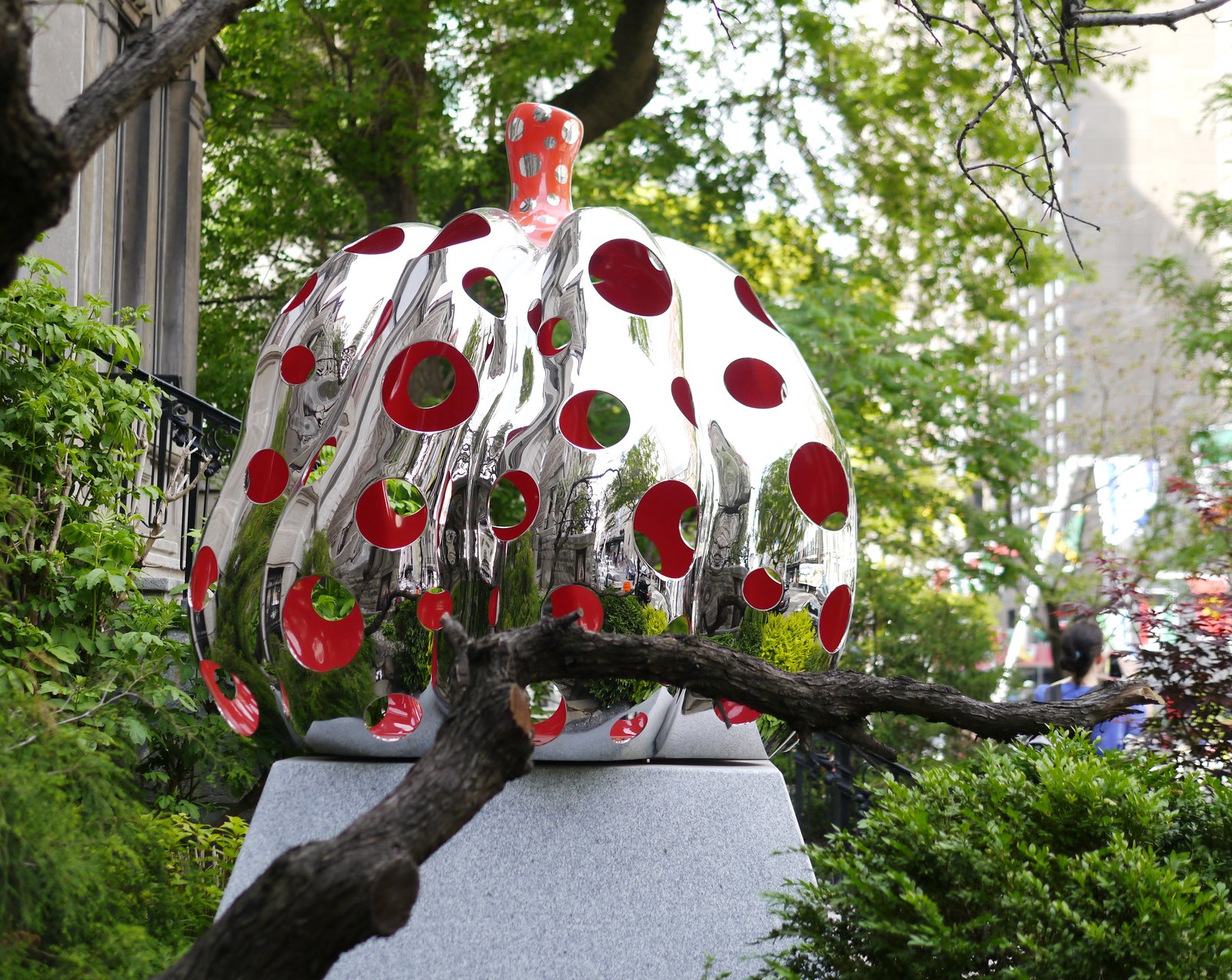
The polka-dotted pumpkin, a form she had been drawing since elementary school, became her most beloved motif. The yellow Pumpkin on the island of Naoshima is now one of Japan's most recognizable public artworks, as ARTnews noted in its obituary.
Her late career was staggeringly productive. She began the My Eternal Soul painting series in 2009 and finished around 900 canvases before closing it in 2021, then started Every Day I Pray for Love. Japan awarded her the Order of Culture in 2016. The Yayoi Kusama Museum opened in Tokyo's Shinjuku district in 2017. Her collaborations with Louis Vuitton in 2012 and again in 2023 put her dots on handbags and shop windows worldwide.
The audience numbers are hard to believe. A 2024 to 2025 retrospective at the National Gallery of Victoria in Melbourne drew 570,537 visitors, the most attended ticketed show in that museum's history. A separate touring retrospective that began at Fondation Beyeler closed at Museum Ludwig in Cologne this month with 480,335 visitors, the most successful exhibition that museum has ever staged. Its final stop opens at the Stedelijk Museum Amsterdam on September 11, where it now becomes a posthumous tribute.
Her record at auction: Untitled (Nets), painted in 1959, sold for $10.5 million in 2022, per Al Jazeera.
That is the same body of work Donald Judd bought into for two hundred dollars, in installments, from a woman nobody was betting on.
Not every chapter was triumphant. In 2023, after SFMOMA opened a Kusama exhibition, reporting drew attention to racist language about Black people in her 2003 autobiography, and she issued a public apology. A full accounting includes that.
Where to See Yayoi Kusama in Miami
Miami holds an unusual concentration of her work, which is not something this city can say about many artists of her rank.
The Rubell Museum in Allapattah presents three major pieces: the Infinity Rooms Where the Lights in My Heart Go (2016) and INFINITY MIRRORED ROOM, LET'S SURVIVE FOREVER (2017), plus Narcissus Garden (1966), 700 stainless steel spheres flowing 200 feet down the museum's central gallery. Mera Rubell has described it as the only museum in the country showing three of Kusama's major interactive works at once. Check the museum's site for current availability before you go, because installations rotate.
Pérez Art Museum Miami also hosted Love Is Calling (2013), one of her largest immersive environments, from March 2023 through February 2024, as Artburst Miami covered at the time. If you want the longer argument for why PAMM anchors the city's art scene, I have made it before.
For a city that spends one week every December convincing itself it is an art capital, the Kusama holdings are the quiet counterargument. They are here in August too.
What She Leaves Behind
David Zwirner, who represented her in the United States from 2013, wrote in his memorial statement that at the time of her death Kusama was "the most famous living artist in the world."
That is true, and it is the smaller part of it.
She took something that tormented her, something that by every conventional measure should have ended her, and built it into a room that strangers would queue for hours to enter so they could feel, for sixty seconds, what she felt all the time. She turned a private hell into public transportation.
She kept painting until nearly the last day of a 97-year life.
The dots go on without her.
Frequently Asked Questions
When did Yayoi Kusama die? Kusama died on August 14, 2026, at a hospital in Tokyo. Her studio and the Yayoi Kusama Foundation announced the death publicly nearly two weeks later.
How did Yayoi Kusama die? The cause was multiple organ failure, confirmed by the David Zwirner gallery, which represented her in the United States.
How old was Yayoi Kusama when she died? She was 97. She was born on March 22, 1929, in Matsumoto, Nagano Prefecture, Japan.
Why did Yayoi Kusama live in a psychiatric hospital? Kusama experienced visual and auditory hallucinations from early childhood. After returning to Japan from New York, she voluntarily admitted herself to a Tokyo psychiatric hospital in 1977 and lived there for the rest of her life, working daily in a studio nearby.
What is Yayoi Kusama best known for? Her Infinity Mirror Rooms, her polka dots, her Infinity Nets paintings, and her polka-dotted pumpkin sculptures. She also made soft sculptures, staged 1960s happenings, and published novels and poetry.
Where can I see Yayoi Kusama's work in Miami? The Rubell Museum in Allapattah holds two Infinity Rooms and Narcissus Garden. Confirm current installations with the museum before visiting.
Will there be a public memorial for Yayoi Kusama? A private funeral has been held for close family members. The foundation has said a public memorial gathering is planned for a later date, though no date has been announced.
Where can I see her work right now outside Japan? Her touring career retrospective opens at the Stedelijk Museum Amsterdam on September 11, 2026, its final stop, now presented as a posthumous tribute.
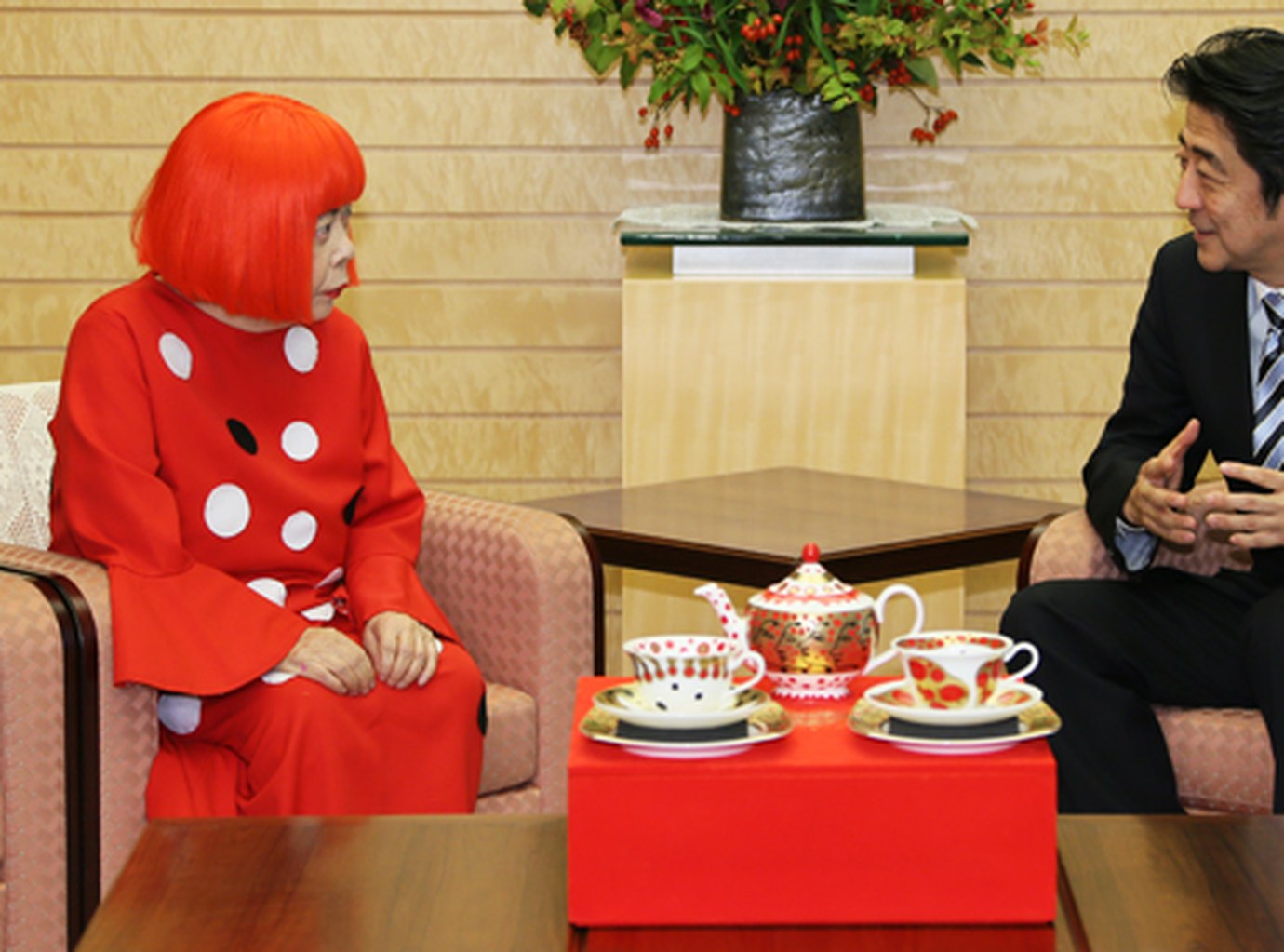
Photographs: Yayoi Kusama at the Prime Minister's Office, 2013, by the Cabinet Public Relations Office, Cabinet Secretariat of Japan, licensed CC BY 4.0. Pumpkin (2015) photographed by art_inthecity, Montreal, licensed CC BY 2.0. Both via Wikimedia Commons.
Lucas D. Boccheciampe
Publisher of The Standard · Broker, Vantage Luxury Real Estate · Key Biscayne