Nathanaëlle Herbelin: The Quiet Painter the Musée d'Orsay Bet On
 By Lucas D. Boccheciampe · July 11, 2026
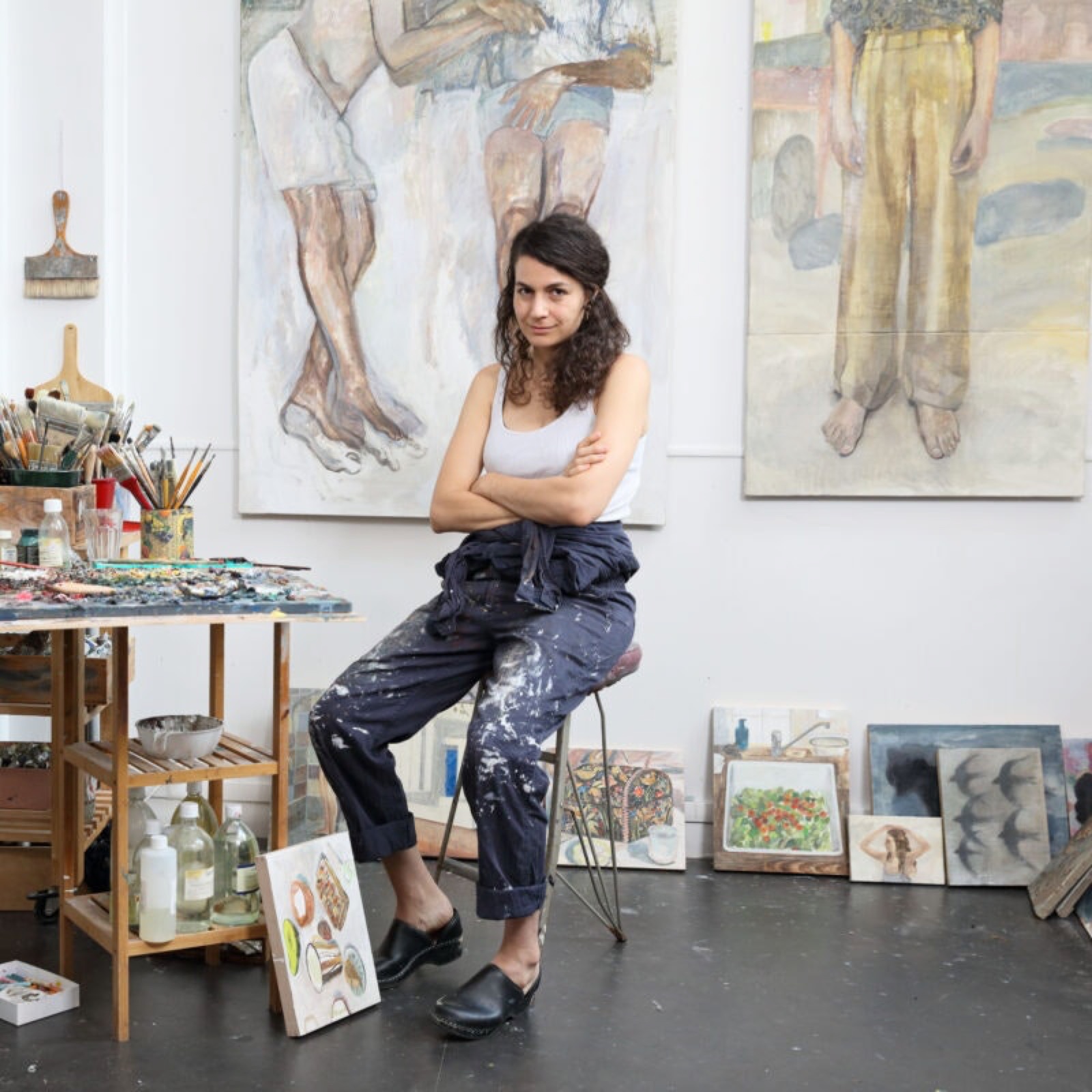
Paris produces painters the way Miami produces condo renderings: constantly, and mostly forgettably. So when the Musée d'Orsay hands its Nabis gallery to a painter born in 1989, I pay attention. That happened in March 2024: a dedicated Nathanaëlle Herbelin exhibition, staged in dialogue with the museum's Nabis collection. Living painters do not get that room by accident.
Who Is Nathanaëlle Herbelin?
Herbelin was born in Tel Aviv in 1989 to an Israeli mother and a French father. She lives and works in Paris, and her oil paintings keep to a deliberately small world: intimate domestic scenes, portraits, couples, still lifes. Earthy palettes. Loose, gestural brushwork. Pictures that hover between memory and presence, a harder trick than it sounds.
The credentials are textbook Paris establishment: an MFA from the École Nationale Supérieure des Beaux-Arts de Paris in 2016, with an exchange year at The Cooper Union in New York in 2015. The following year she joined Galerie Jousse Entreprise, which mounted her first solo exhibition. She made her name painting the people closest to her, then widened the circle to strangers she encountered in the street, alongside still lifes inspired by Giorgio Morandi.
A Style Rooted in the Nabis
Herbelin cites Les Nabis, the late-19th-century Parisian group that included Pierre Bonnard, Édouard Vuillard, and Félix Vallotton, as a central influence, particularly their attention to domestic scenes and everyday life. Critics add Morandi's stillness and the quiet interiors of the Danish painter Vilhelm Hammershøi; her earth tones and loose handling, meanwhile, recall the Post-Impressionists.
Her response to the Hammershøi comparison is the tell. She calls the connection emotional rather than stylistic, given the distance between his cooler Nordic light and the warmth of her Israeli upbringing.
The craft evolved too. In recent years she has worked with a calcium carbonate binding agent and rabbit-skin glue to recreate, on large canvases, effects she originally achieved painting on wood: surfaces as delicate as porcelain. Nobody stumbles into that.
The Musée d'Orsay Moment
Museum validation comes in tiers. A group show is a nod; an acquisition is a handshake. The Orsay's March 2024 show was another category entirely: Herbelin's paintings hung in the gallery devoted to the Nabis' own works. The cynical read says museums hang young painters to look current. The placement argues back. Her canvases updated the movement's classic subjects (domestic interiors, intimacy, everyday gestures) with the furniture of the present: cell phones, laptops. Bonnard's world, running today's software.
Collections, Galleries, and the Basel Circuit
Herbelin is represented by Galerie Jousse Entreprise in Paris and Xavier Hufkens in Brussels. Her paintings are held in the permanent collections of the Musée d'Art Moderne de la Ville de Paris, the Stedelijk Museum in Amsterdam, S.M.A.K. in Ghent, the Pinault Collection in Paris, and the Tel Aviv Museum of Art. She has shown on the Art Basel circuit as well, including Veillée d'armes, a duo presentation at Paris+ by Art Basel in October 2022. My Art Basel Miami 2026 guide covers why fair placement still matters to a painter's trajectory.
What Collectors Should Take From This
Herbelin's rise fits a shift I've flagged before: collectors are choosing humans over AI, returning to slow, first-person painting no algorithm can fake. Her file is a case study in how that preference gets institutionalized: rigorous training, galleries in Paris and Brussels, museum collections across Europe and Israel, an Orsay show.
Here is the tension. Validation this loud is great news for the artist and rough news for the bargain hunter, because quiet work with real fundamentals eventually gets loud backing, and by the time it does, the discount is gone. The discipline is reading those fundamentals before a museum makes the argument for you. If you want a second set of eyes on an acquisition, that is what my art advisory practice is for. The Orsay already did its due diligence. It published the findings in its best room.
Lucas D. Boccheciampe
Publisher of The Standard · Broker, Vantage Luxury Real Estate · Key Biscayne