Chromosaturation at PAMM: Is Colored Light Really Art?
Carlos Cruz-Diez filled three rooms at PAMM with red, green and blue light and left out the painting entirely. The show closed September 27, 2026. The question stays open.
 By Lucas D. Boccheciampe · October 28, 2026
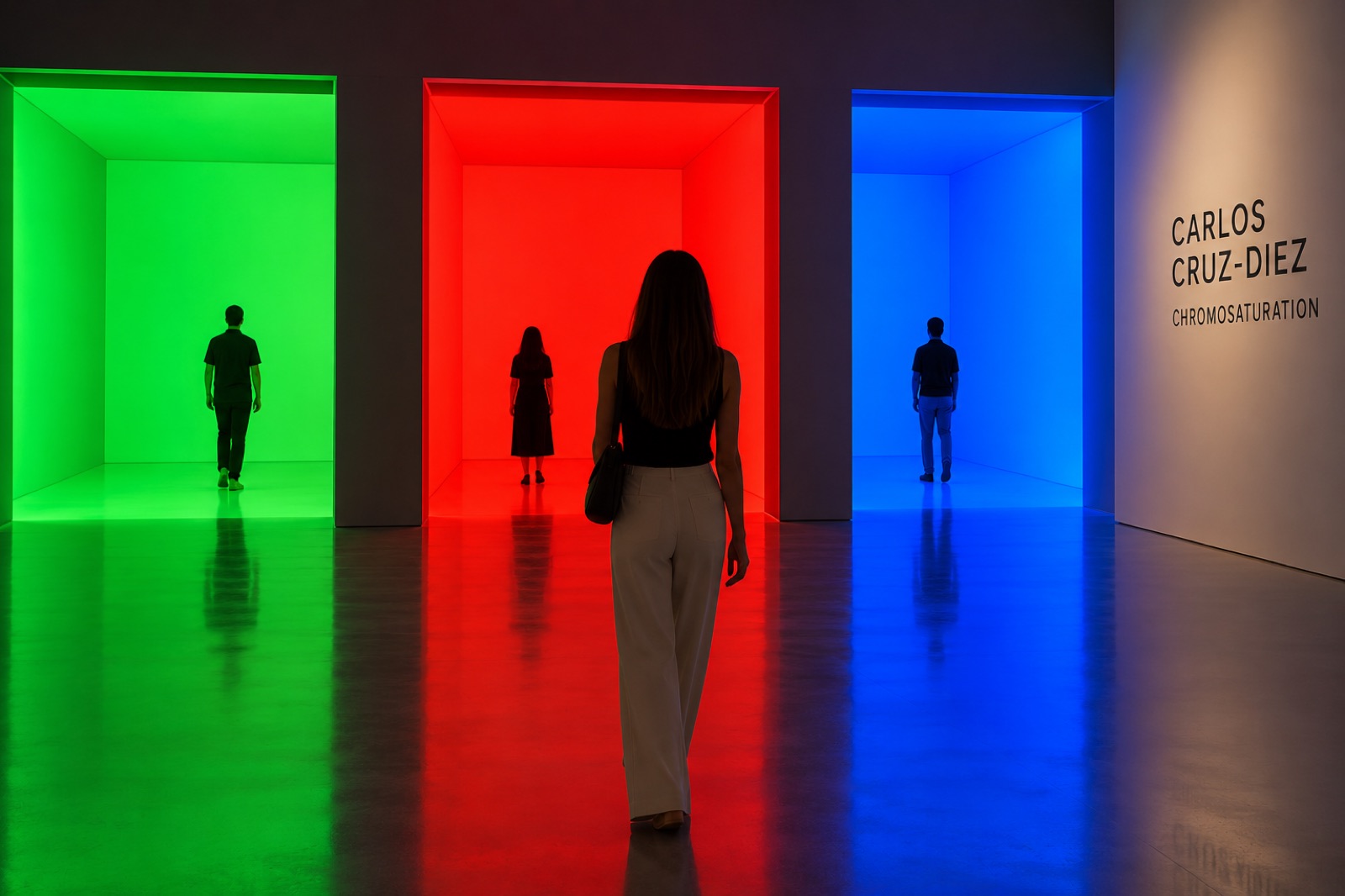
You walk into a room and the room is green. Not green walls. Green light, saturated to the point where your own hand looks like it was borrowed from somebody else. Two minutes later you step into red and your eyes file a formal complaint. Then blue, and the complaint gets louder.
Somewhere in there the question arrives without anyone having to put it on a wall label: are you looking at art, or are you standing inside it?
That is Chromosaturation, an installation by the Venezuelan artist Carlos Cruz-Diez, and it was on view at Pérez Art Museum Miami until September 27, 2026.
Three numbers that explain Chromosaturation
- 1965. The year Cruz-Diez first conceived the work.
- 3. The number of connected chambers in the PAMM presentation, one red, one green, one blue.
- 2. The minutes PAMM recommends you spend in each chamber before moving to the next.
That last number is the sleeper. Most museum labels do not come with a recommended dwell time. This one does, because the work does not happen on the wall. It happens in your retina, and your retina needs a minute to catch up.
What the work actually does to your eyes
PAMM's explanation is refreshingly unmystical. Your eyes normally take in many colors at once. Surround them with a single intense color and the retina gets overwhelmed, which changes how you perceive color altogether. Walk from green into red and your perception adjusts. Continue into blue and it shifts again.
PAMM asks visitors to watch for exactly that: how your skin looks, how your clothes look, how the color around the doorways behaves once you are inside a different chamber. The museum is essentially handing you a lab notebook and telling you that you are both the instrument and the experiment.
Which reframes the standard museum question. Instead of asking what am I looking at, Chromosaturation asks what am I experiencing. Those are not the same question, and only one of them can be answered from across the room.
Who Carlos Cruz-Diez was
Cruz-Diez (1923 to 2019) was a Venezuelan artist and, in PAMM's description, a pioneer of kinetic and Op art. Color was the whole project. Rather than treating color as a fixed property of an object, he investigated how it shifts through light, movement, space, and the participation of whoever shows up to look.
That last ingredient is the radical one. In Chromosaturation, your walk through the chambers is not preparation for the artwork. It is a component of it. Show up, move around, and you have changed the piece. The museum did not install a thing so much as it installed a condition.
If you want the wider frame for why a museum like this matters to the city, our piece on why PAMM anchors Miami's art scene covers the institutional side.
The twist: you cannot hang this above the sofa
Here is where it gets interesting for anyone who thinks about art as an asset rather than an afternoon.
An enormous amount of the art economy runs on objects. Things you can crate, insure, ship, authenticate, resell, and photograph above a fireplace. Chromosaturation refuses almost all of that. The medium is colored light and the delivery mechanism is your own visual system. You cannot take it home. You cannot put it in a vault. You can only be in the room while the lights are on.
The work itself poses the question more bluntly than any critic would: is experiencing art more important than owning an art object? In a city where the art conversation tilts heavily toward acquisition, that is an awkward thing to have blinking away in three colors. We have written before about the economics underneath Art Basel and why emerging artists matter, and this installation sits at the opposite end of that same argument.
There is no correct answer. That is the point.
About the PAMM presentation
- Where: Pérez Art Museum Miami (PAMM), 1103 Biscayne Blvd., Miami, FL 33132.
- Exhibition: Carlos Cruz-Diez: Chromosaturation.
- Run: The presentation opened October 2, 2025 and closed September 27, 2026.
- How long: At least two minutes per chamber, per PAMM's own recommendation.
- Official details: pamm.org exhibition page
The takeaway
Chromosaturation is the rare piece of immersive art that requires zero homework. You do not need to know the history of kinetic art, you do not need to have an opinion about Op art, and you do not need to pretend to understand a wall text written in six hundred words of theory. You walk in and you ask one question: what is happening to the colors I see?
That accessibility is the whole trick. It made the show a good first stop for anyone who had been meaning to get into the Miami art scene and was quietly intimidated by it. The barrier to entry was a door.
The Miami run closed on September 27, 2026. The question it asked did not.
So, is it still art if there is no painting to look at? PAMM presents and collects it as an artwork. That part is settled. Whether it lands for you personally is a matter of interpretation, and the only way to find out is to stand in the green room.
You cannot own the light. You can only be there while it is on.
Chromosaturation at PAMM: quick answers
What is Chromosaturation? An immersive installation conceived by Carlos Cruz-Diez in 1965. The PAMM installation consists of three connected chambers lit in red, green and blue.
Who was Carlos Cruz-Diez? A Venezuelan artist (1923 to 2019) known for investigating color and perception. PAMM identifies him as a pioneer of kinetic and Op art.
Where was it shown in Miami? Pérez Art Museum Miami, 1103 Biscayne Blvd., Miami.
When did it close? September 27, 2026.
How many rooms were there? Three interconnected color chambers: green, red and blue.
How long should I spend inside? PAMM recommends at least two minutes in each chamber to experience the change in color saturation.
Is it a painting? No. PAMM describes it as an immersive installation in which visitors enter interconnected spaces filled with colored light.
Is it really art? PAMM presents and collects it as an artwork. Whether you find the experience beautiful, interesting or meaningful is personal interpretation.
Lucas D. Boccheciampe
Publisher of The Standard · Broker, Vantage Luxury Real Estate · Key Biscayne