John Baldessari at PAMM: Can a Colored Dot Really Be Art?
PAMM's John Baldessari exhibition puts roughly 40 works and five decades on the wall, then asks the question that matters: if you could make it, is it still art?
 By Lucas D. Boccheciampe · November 19, 2026
In 1970, John Baldessari asked five friends to help him burn his own paintings. Paintings in his possession that he had made between 1953 and 1966, incinerated on purpose, as part of the work.
PAMM includes that fire in the story of his move toward conceptual art, and it reads like a hinge, the moment Baldessari stopped arguing with conventional painting and simply left the room. It also leaves a question sitting in the gallery. If an artist destroys his own paintings as part of an artistic project, where exactly is the art? In the paintings? In the destruction? In the idea?
There is no factual answer. That is not a flaw in the exhibition. That is the exhibition.
What Is On View at PAMM
John Baldessari: The End of the Line gathers approximately 40 works spanning five decades, including painting, photography, video and installation. Three numbers to anchor it: 40 works, five decades, one artist (1931 to 2020) who spent most of that career suggesting the object on the wall was never really the point.
PAMM lists the show from August 20, 2026 through May 9, 2027, a run that stretches deep into next year. This is not a weekend pop-up you have to catch. It is a standing invitation to argue with yourself.
Why Did John Baldessari Put Colored Dots Over Faces?
The colored circle over the face became his most recognizable move, and it is the reason casual visitors either lean in or roll their eyes.
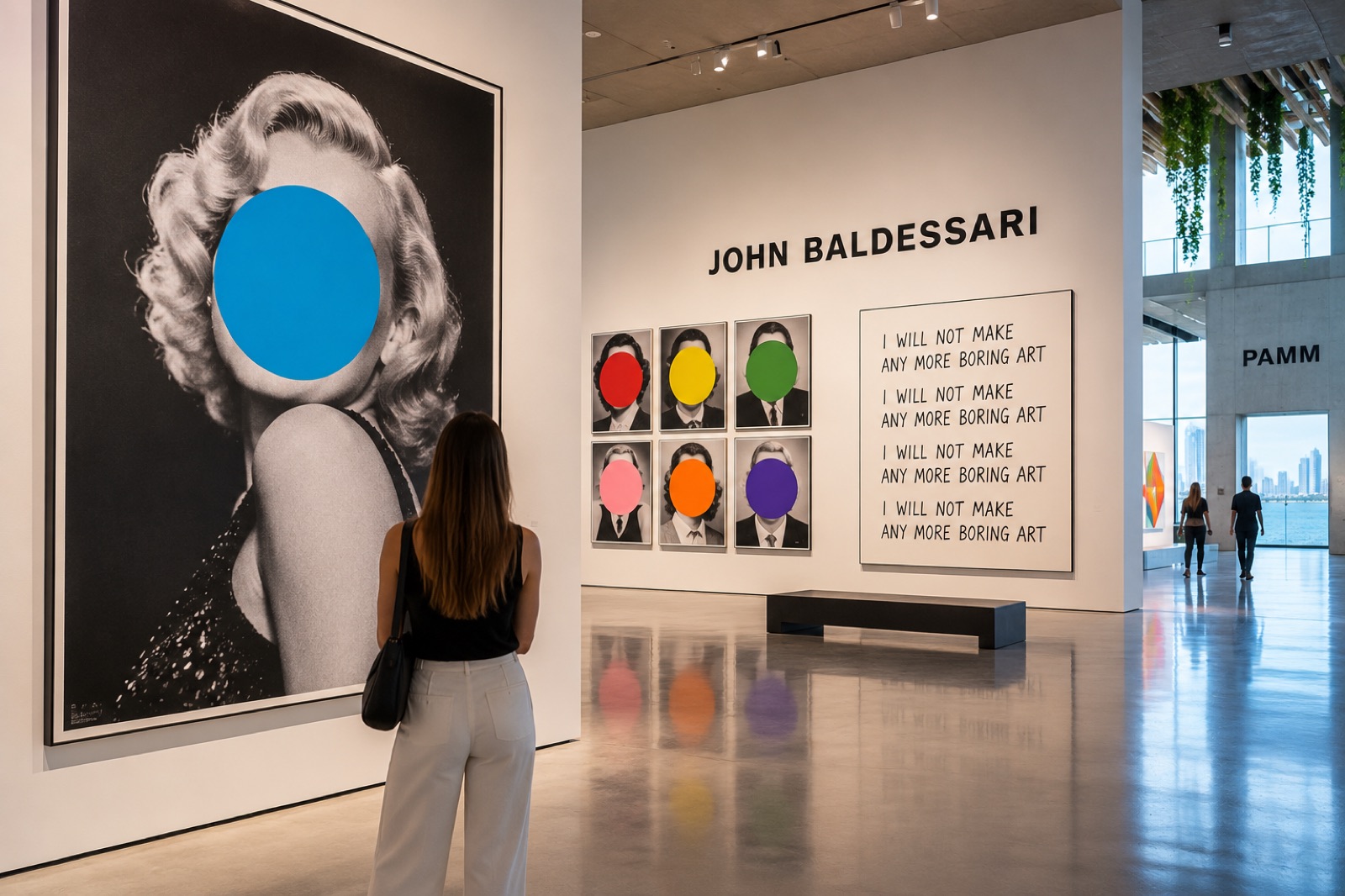
PAMM explains that Baldessari obscured faces and other parts of images while exploring questions about art and perception. In works such as Face (With Brown Nose) and Face (With Blue Nose), adding color to an otherwise overlooked facial feature changes what pulls your attention.
You can test it without leaving your chair. Picture a photograph of several people. Where do your eyes go first? The faces. Every time. Now cover those faces with bright circles. Suddenly you are looking at hands, posture, the gap between two strangers, the wallpaper.
The dot is not decoration. It is a redirect. He removed the one thing your brain was guaranteed to look at, and in doing so made you notice everything you were about to ignore.
What Conceptual Art Actually Means
Conceptual art gives the idea behind the work top billing. The execution matters, but it is not the headline.
Baldessari spent much of his career questioning traditional expectations about what art should look like and how images and words communicate. His clearest statement of that is also his driest. I Will Not Make Any More Boring Art, created in 1971, repeats that single sentence in rows that look like handwriting exercises.
The work is not difficult to read. Deciding why repeating those words becomes an artwork at all takes considerably longer. That gap, between how quickly you can consume the thing and how long it takes to resolve it, is where Baldessari lived.
What This Means for Miami Art Audiences
Miami's art conversation tends to spike around fair season and flatten out the rest of the year. The fairs are loud, transactional and genuinely important, especially for emerging artists trying to get paid.
A show that runs from August into the following May is the opposite of that rhythm. Nothing is competing for your attention. There is no VIP hour, no collector scrum, no booth number. Just the work, the wall text and whatever you walked in with.
That is the case for treating PAMM as the year-round spine of the city's art scene rather than one stop on a December route. The fairs move the money. The museum moves the argument.
The Takeaway
Stand in front of a Baldessari and you will probably have the standard reaction: could I make this? Usually, yes. A colored circle over a face is not technically demanding. Neither is writing one sentence over and over in neat rows.
But that is the easy question, and answering it gets you nowhere. The harder one is the one the show keeps handing back to you. If you could make it, does that mean it is not art?
Baldessari's colored-dot works are exhibited and studied as artworks. Whether you think they are good art is a different question, and it belongs to you, not to the museum.
He burned paintings from thirteen years of his own work to stop answering that question, then spent the next five decades making sure everyone else had to.
How to See John Baldessari: The End of the Line
- Where: Pérez Art Museum Miami (PAMM), 1103 Biscayne Blvd., Miami, FL 33132
- When: PAMM lists the exhibition from August 20, 2026 through May 9, 2027
- What is in it: approximately 40 works spanning five decades, including painting, photography, video and installation
- Past programming: PAMM held Free Second Saturday: Dots, Words, and Wonder, an event inspired by the exhibition, on September 12, 2026
- Official details: PAMM's exhibition page
Bring the friend who says they do not get conceptual art. Then time how long they stand in front of the dots.
Lucas D. Boccheciampe
Publisher of The Standard · Broker, Vantage Luxury Real Estate · Key Biscayne