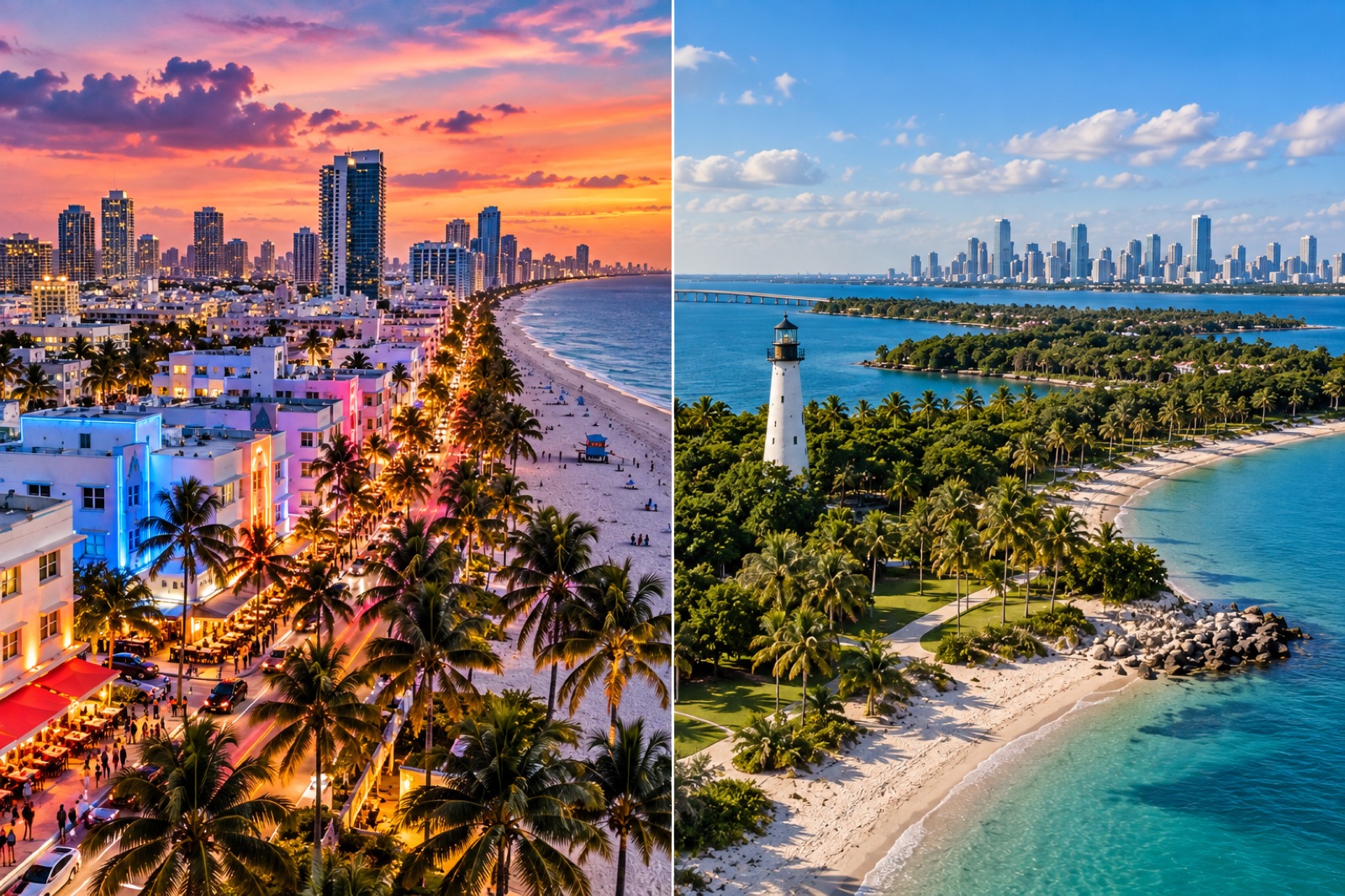
Real Estate in Miami: A Verified Guide for Buyers and Investors
 By Lucas D. Boccheciampe · July 17, 2026
Every few cycles, someone declares Miami real estate finished. Overbuilt, overheated, over. Then Florida adds another wave of new residents, and the line at the closing table gets longer.
For buyers between 40 and 60, whether you are writing your first offer or your fifth, Miami keeps landing on the shortlist for the same reason: it sells a lifestyle and a balance sheet at the same time. According to the National Association of Realtors, Florida leads the nation in foreign real estate investment activity. That is not a beach-town stat. That is a global-capital stat.
Why Miami trades like a global city
Miami stopped being a regional market a long time ago. It runs on deep connections to Latin America and Europe, which keeps demand competitive even when the rest of the country cools. The U.S. Census Bureau ranks Florida among the fastest-growing states in the country, and the Florida Department of Revenue confirms the part every buyer eventually repeats at dinner: no state income tax.
Put those together and you get a market where lifestyle and math point in the same direction.
What the numbers actually say
The headline figure is simple. Realtor.com puts the median listing price in Miami above five hundred thousand dollars, a reflection of steady demand and a growing population. Zillow's data shows home values rising steadily over time, and Redfin describes a market that stays competitive, with strong buyer demand running ahead of relatively low inventory.
Low supply, high demand, international money. You do not need a finance degree to see which way that pressure points.
The neighborhoods that anchor the market
Miami is not one market. It is several stacked on top of each other.
- Brickell is the financial center, drawing professionals and investors with modern towers and strong rental demand.
- Miami Beach is the luxury and waterfront story. Knight Frank ranks Miami among the top global luxury markets, and the Beach is where much of that trophy inventory lives.
- Coral Gables is the stability play, favored by families and long-term investors who want upscale without the churn.
The same logic scales down the coast. On Key Biscayne, for instance, houses and condos trade in almost entirely separate markets, which is exactly why a single citywide median can mislead.
Condo, house, or trophy
Property type is really a question of how much responsibility you want. Condominiums come with amenities and lower maintenance, which is why they are often the entry point for new investors. Single-family homes trade that convenience for space and privacy, and demand for them has climbed sharply in recent years. At the top, Sotheby's International Realty highlights Miami as a key global luxury destination, which is a polite way of saying the ceiling here is very, very high.
The upside, stated as analysis, not a promise
Here is where honest beats hype. The Federal Housing Finance Agency reports steady home price appreciation in Florida over time, which supports the long-term case. Miami's tourism engine keeps rental demand strong, and AirDNA data shows high occupancy rates for short-term rentals. And that no-income-tax line is not just cocktail trivia. It is a real advantage for investors keeping more of what they earn.
None of that is a guarantee. It is a pattern. Patterns are useful right up until you treat them as certainties.
The part the brochures skip
Now the twist. The same water that sells the postcard also writes the risk report. FEMA maps place many Miami areas in flood zones, and the Insurance Information Institute reports that Florida carries some of the highest home insurance premiums in the country. Layer on the fact that S and P Global's historical data shows housing markets move in cycles, and the picture sharpens. Paradise has a line-item cost, and it shows up on the insurance bill.
Smart buyers price flood risk and insurance in from the first showing, not after the inspection.
How the buying actually works
Budget for everything, not just the down payment. Closing costs and insurance are part of the real number, and mortgage rate trends are worth tracking through Freddie Mac before you lock anything in. Work with licensed professionals so the legal side stays clean. Most closings run thirty to sixty days depending on financing and paperwork.
Financing comes down to fixed-rate versus adjustable-rate, chosen against your own timeline. And for international buyers, the door is open: foreign investors can purchase U.S. property, with guidelines published by the U.S. Department of the Treasury.
The takeaway
Miami's economy is widening into finance and technology while the Census Bureau projects continued population growth in Florida. More jobs, more people, the same finite coastline. Beginners are usually best served starting with a well-located condo in an area with real rental demand. Experienced buyers spread across neighborhoods and property types to manage risk.
The verified version of the Miami story is less dramatic than either the hype or the doom, and a lot more useful than both.
In Miami, the beaches sell the dream and the spreadsheet decides whether you get to keep it.
Lucas D. Boccheciampe
Publisher of The Standard · Broker, Vantage Luxury Real Estate · Key Biscayne